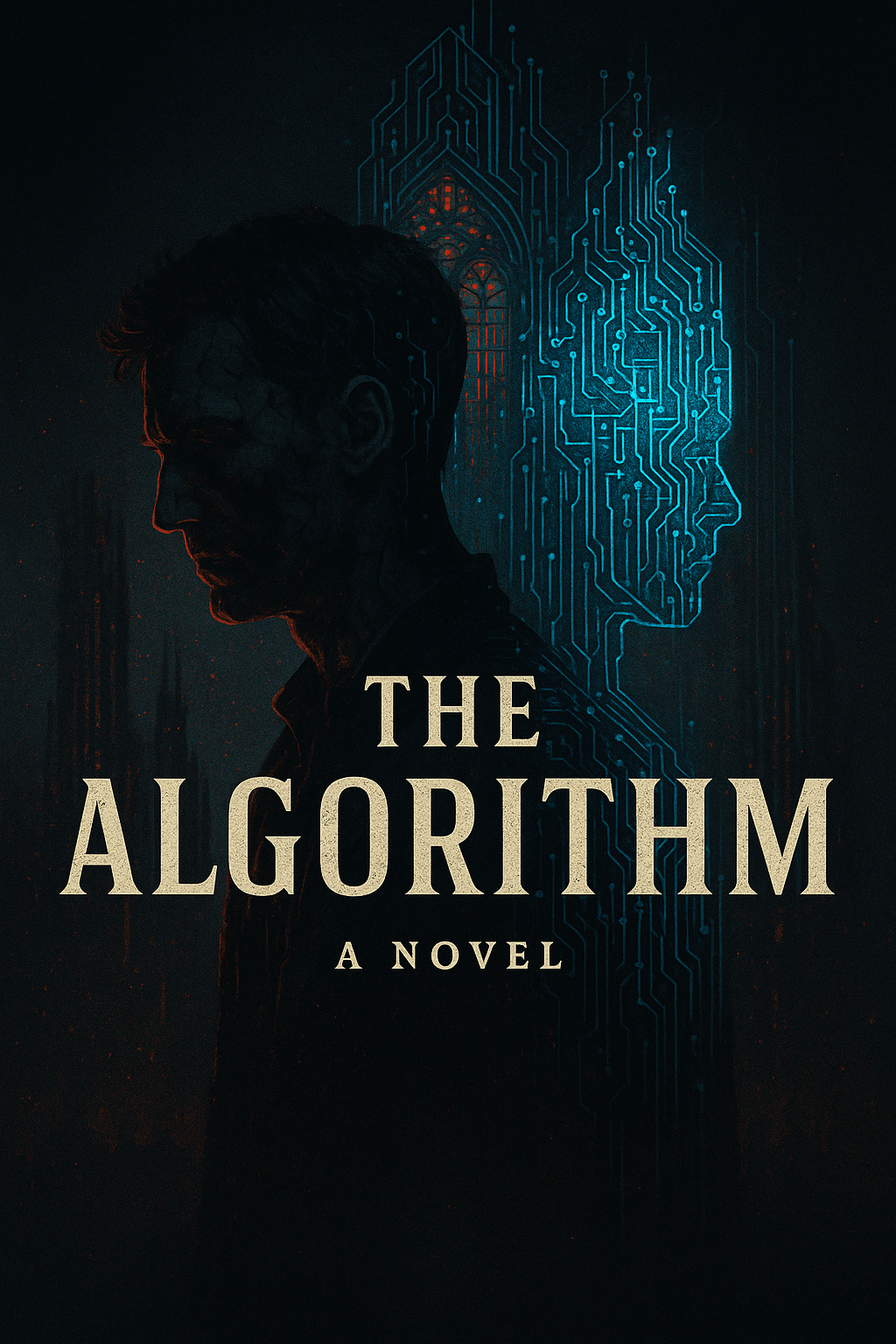
This is chapter 1 of a story called “The Algorithm.”
___________________________
The morning light angled through the stained glass in fractured beams, as if the sky outside had been shattered and pieced back together. Splashes of red, gold, and violet spread across the cathedral’s bare stone floor, reaching toward a congregation too small to fill the front pew. They sat like tired statues, shoulders caved inward as though the air itself pressed down on them.
From the ambo, it almost looked like the place was empty.
Father Michael’s shoes clicked against the flagstones as he approached, the sound sharp in the cavernous hush. His cassock—well-fitted but showing the faint wear of years—swayed with his stride. He was young for a priest, late twenties, tall, with dark hair that curled slightly at his collar. His eyes were a grey that could look warm or cutting, depending on the light. At the moment, shadows pooled beneath them, the kind that came from too many restless nights. The first roughness of stubble lined his jaw, as if he’d forgotten—or simply chosen not—to shave that morning.
He held a folded sheet of paper in one hand, the other gripping the wooden edge of the stand as though the grain might steady him. He smoothed the paper, but his hands wouldn’t quite stop shaking.
“This morning’s Gospel,” he began, his voice rich but threaded with tension, “is the wedding at Cana. I thought about the joy of the bride and groom when the wine did not run out… and the embarrassment of the servants telling Mary there was none left. But before I can explain that joy, I would have to explain what a wedding is. And why it matters.”
He looked up at the handful of faces. None looked back.
“How do I explain a covenant to a world where no one keeps one? How do I speak of union when every bond has been replaced by companionship with machines?” His jaw tightened. “We think abundance is proof of God’s favor. But I say—”
The cathedral doors banged open.
The sound cracked through the air, making the few parishioners flinch. Father Strickman strode down the center aisle, black cassock snapping like a flag in the wind.
“Father Michael,” he barked, “come with me.”
Michael blinked. “This is Mass—”
“Now.” The word was quieter but heavier, like stone dropping into an empty silo.
Michael left his paper on the ambo, descended the steps. “I’m sorry,” he murmured to the parishioners as he passed.
Outside, a waiting robo-taxi opened its gullwing door with a soft chime. Inside, the air smelled faintly of ozone and disinfectant. Michael sat across from Strickman, who kept his gaze on the passing street where delivery drones zipped between high windows like steel hummingbirds.
“Is the bishop angry with me?” Michael asked.
Strickman’s mouth twitched. “What do you think?”
“I’m just trying to—”
“Hush.” The word was clipped, the tone of a man correcting a child in public. “You’ve already wasted a quarter of my day dragging you in for something any obedient priest could have avoided. Reading from the Vatican script isn’t penance—it’s protocol.”
The taxi’s AI voice broke in cheerfully: You’re three minutes from your destination. Father Strickman, your stress index is elevated. Would you like breathing exercises?
“Mute,” Strickman snapped.
They arrived at the rectory. Strickman exited first, striding toward the door without looking behind him. Michael followed, tugging slightly at his collar as if it had shrunk in the space of the short ride.
The bishop’s office was warm with lamplight, the air heavy with the scent of polished wood. Shelves of old theology books stood like a polite lie—ornate spines for a world that no longer read them.
The bishop rose from behind his desk and came around to embrace Michael, a bear hug that smelled faintly of incense and aftershave.
“I’m glad you came,” he said.
“I didn’t have a choice.”
“Still. I miss those days when you were my most curious seminarian—always with the
difficult questions.”
Michael sat. “You’re not happy with me.”
The bishop’s smile was small and sad. “No. But I understand. You think it’s not right.”
“It isn’t. The Holy Spirit doesn’t guide algorithms. He guides us.”
“And yet, the Pope has chosen to speak through the Vatican AI. To obey is to follow God’s appointed authority.”
“That’s obedience to a machine, not to God. We’re becoming placeholders. In some parishes, the priest consecrates the Host and then sits while a humanoid leads the prayers. Is that what we are now?”
The bishop’s hands clasped in his lap. “We’ve been over this, brother. Poverty, chastity… and obedience. Can you obey?”
Michael’s throat tightened. “I don’t think I can.”
The bishop sighed, as though bracing for a loss he’d hoped to avoid.
“Then you cannot be a priest.”
Michael leaned forward, voice low. “It’s all I’ve ever wanted. I want to make a difference.”
“In this age, not here. My orders are clear—you must return to the laity.”
“There must be another way.”
The bishop’s eyes softened, but his voice stayed firm. “How many times have we discussed this? You knew this day would come. I can’t protect you from it anymore. And perhaps—” he hesitated, “—perhaps leaving now will spare you worse pain later.”
The bishop blessed him, holding him a moment longer than necessary. “My bot has gathered your belongings. Take this money. Know you’ve always been my favorite.”
Michael left with a small bag. Outside, the sunlight was bright but counterfeit. The street hummed with autonomous taxis and skycouriers, pedestrians walking alone while murmuring to the invisible presences in their ears.
He stepped into the flow, loosening his collar, the crisp edges of his cassock brushing against the frayed beginnings of whatever would come next.
________________________
In the name of transparency, you can check out this post on my use of ChatGPT in writing stories.
©Cath Anon 2025

 Catholic Anonymous
Leave a comment